Wild Wonders Seen from the Edge: My Galapagos Awakening
Stepping onto the Galapagos felt like entering another world—where lava fields meet turquoise waves and animals stare at you like you’re the odd one out. I’d heard it was special, but nothing prepared me for the raw, untamed beauty. This isn’t just a trip; it’s a front-row seat to evolution in action. Here, every viewpoint tells a story millions of years in the making. The air is dry and salty, the sun bright and unrelenting, and the silence between bird calls feels sacred. In this remote archipelago, nature operates on its own terms, untouched by time in ways few places on Earth still can claim. To walk these islands is to witness life as both fragile and resilient, shaped by isolation, volcanic fire, and the slow rhythm of adaptation.
First Footsteps: Arriving in a Living Laboratory
The journey begins on Baltra Island, a narrow strip of land that serves as the primary gateway for travelers arriving by air. The runway cuts through a stark, sunbaked landscape of volcanic rock and low-lying shrubs, where spiny cacti rise like sentinels and marine iguanas scuttle across the tarmac with unhurried confidence. There is no grand terminal, no bustling arrivals hall—just a modest building and a sense of transition, as if the islands are quietly reminding visitors: you are no longer in the world you know. From Baltra, most travelers cross the Itabaca Channel by ferry to Santa Cruz, one of the most accessible and visited islands in the chain, yet still profoundly wild at its core.
As the boat glides over the channel’s calm waters, the silhouette of Santa Cruz emerges—rolling highlands veiled in mist, surrounded by jagged coastlines. The contrast between the arid lowlands and the lush interior is immediate and striking. This duality defines much of the Galapagos experience: fire and water, barrenness and abundance, isolation and interconnectedness. Upon arrival, the first wildlife encounters are often the most jarring. A blue-footed booby perched on a rock, tilting its head with curious disinterest. A land iguana lumbering past a park bench. These animals do not flee. They do not perform. They simply exist, unbothered by human presence, a testament to the absence of natural predators and the success of long-term conservation efforts.
The Galapagos Islands lie nearly 600 miles off the coast of Ecuador, formed by volcanic activity along the Nazca Plate. Their geographic isolation has allowed species to evolve independently, leading to an extraordinary level of endemism—over 80% of the land birds, 97% of the reptiles, and 30% of the plants found here exist nowhere else on Earth. This makes the archipelago one of the most significant natural laboratories in the world. Charles Darwin’s visit in 1835 helped shape his theory of natural selection, and today, scientists continue to study evolutionary processes in real time.
To protect this irreplaceable ecosystem, strict biosecurity measures are enforced. All luggage is inspected upon arrival to prevent the introduction of invasive species—seeds, insects, or soil that could disrupt delicate balances. Travelers are briefed on protocols: clean footwear, no food from outside the islands, and mandatory adherence to guided tours in protected zones. These rules are not bureaucratic hurdles; they are essential safeguards. Each step taken on Galapagos soil carries responsibility, not just privilege.
The High Ground: Why Viewpoints Define the Galapagos Experience
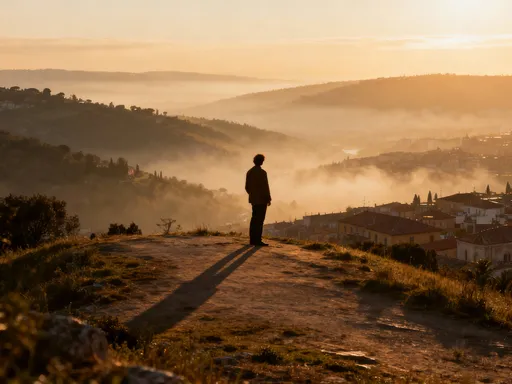
Elevation changes everything. From the highlands of Santa Cruz to the rim of an extinct volcano on Isabela, gaining altitude offers more than panoramic vistas—it provides context. The Galapagos is not a single destination but a collection of islands, each with its own geological personality and ecological story. Standing above them allows travelers to see the archipelago as a whole: a chain of volcanic peaks rising from the Pacific, shaped by millennia of eruptions, erosion, and biological colonization.
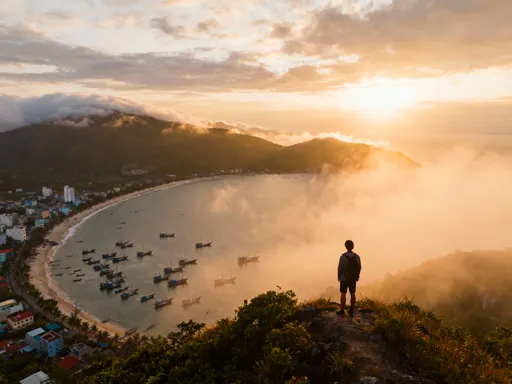
One of the most revealing vantage points is Cerro Crocker, the highest point on Santa Cruz, though access is limited to protect fragile highland ecosystems. More accessible is Cerro Tijeretas on San Cristóbal Island, a saddle-shaped hill that offers sweeping views of Wreck Bay and the distant silhouette of Española. From this perch, the relationship between the islands becomes visible. You can trace the curve of coastlines, identify nesting sites on remote cliffs, and understand how wind and ocean currents influence species distribution. The layered rock formations tell a geological tale—each band a different eruption, each crater a moment frozen in time.
These elevated perspectives do more than satisfy curiosity; they deepen understanding. Seeing the islands from above underscores their fragility. What appears from sea level as a rugged but enduring landscape reveals, from above, how small and scattered these landmasses truly are. They are not vast continents but isolated outposts, each a self-contained experiment in survival. This awareness shifts the traveler’s mindset from passive observer to engaged witness. The Galapagos is not a zoo or a theme park—it is a dynamic, evolving system where every species, from the smallest insect to the giant tortoise, plays a role.
Moreover, these highland trails often pass through unique ecosystems. On Santa Cruz, the transition from arid zones to humid highlands supports scalesia forests—dense, moss-draped woodlands named after the daisy tree that dominates them. These forests are home to endemic birds like the Galapagos flycatcher and the vermilion flycatcher, whose bright red plumage flashes like a spark in the green canopy. Walking through them feels like stepping into a prehistoric world, where time moves differently and life adapts in quiet, persistent ways.
Coastal Perspectives: Where Land Meets Evolution
While the highlands offer sweeping context, the coastlines deliver intimacy. The Galapagos’ shorelines are where evolution feels most immediate—where animals live, breed, and interact in full view. Punta Suarez on Española Island is one of the most dramatic examples. A rugged trail winds along towering cliffs carved by wind and waves, where waved albatrosses return each year to nest. From April to December, these magnificent birds perform their elaborate courtship dances—clacking bills, spreading wings, and calling into the wind. For many visitors, it is a moment of awe, not just for the spectacle, but for the realization that such rituals have unfolded here for thousands of years, undisturbed.
Nearby, red-billed tropicbirds glide along the updrafts, their tail streamers trailing like ribbons. On the rocks below, Nazca boobies stand in silent pairs, while sea lions sprawl across sun-warmed lava, pups squealing as they tumble into tide pools. The intertidal zones are alive with color and motion. Sally Lightfoot crabs, with their crimson shells and electric blue legs, dart between crevices, feeding on algae and detritus. These crabs, once nearly hunted to extinction for food, now thrive under protection, a quiet victory of conservation.
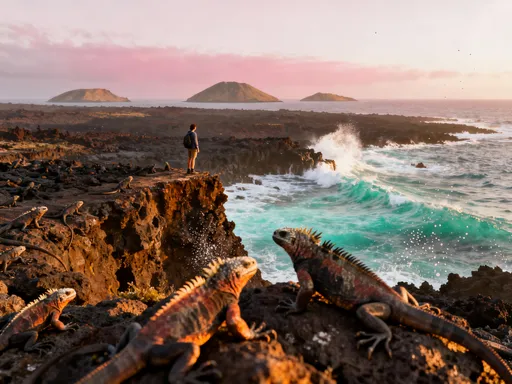
Other coastal sites offer equally powerful encounters. Puerto Egas on Santiago Island features a black sand beach and a coastline shaped by tuff cones and lava flows. Here, visitors can walk along a natural staircase of solidified lava, where tide pools teem with life—marine iguanas basking on rocks, small reef fish darting through clear water, and occasionally, a Galapagos penguin perched on a shaded ledge. At low tide, the pools become miniature aquariums, revealing sea stars, anemones, and octopuses hiding in shadowed corners.
On Genovesa Island, known as the “Bird Island,” the coastline transforms into a nesting haven for frigatebirds, red-footed boobies, and storm petrels. The cliffs and mangrove-fringed shores create sheltered spaces where generations of birds return to breed. Unlike in many parts of the world, there are no barriers, no fences—just open trails and the quiet presence of rangers ensuring that human observation remains non-intrusive. This access is rare and precious, a privilege granted only because the ecosystem remains intact.
Beneath the Surface: The Underwater Viewpoint
If the land offers wonder, the sea offers transformation. Snorkeling in the Galapagos is not merely a recreational activity—it is a portal into another dimension. The convergence of three major ocean currents—the cold Humboldt, the warm Panama, and the nutrient-rich Cromwell—creates one of the most biologically diverse marine environments on the planet. Visibility often exceeds 100 feet, and water temperatures range from 60 to 75 degrees Fahrenheit, requiring wetsuits for comfort but rewarding with unforgettable encounters.
One of the most iconic sites is Kicker Rock, a dramatic tuff cone that rises vertically from the sea, split in two by erosion. Snorkelers drift along the channel between the rocks, where currents bring a constant flow of marine life. Sea turtles glide past with slow, deliberate strokes. White-tipped reef sharks rest on the sandy bottom. Schools of king angelfish, creole fish, and yellow-tailed surgeonfish swirl in synchronized patterns. Occasionally, a Galapagos shark—a larger, more powerful predator—moves through the deeper water, a reminder of the ocean’s hierarchy.
Even more extraordinary is Devil’s Crown, an eroded volcanic crater on Floreana Island that forms a horseshoe-shaped reef. Inside the ring, the water is calm and shallow, ideal for beginners. Outside, strong currents attract larger species. Snorkelers may find themselves surrounded by parrotfish, moray eels, and even juvenile sea lions that dart in and out with playful curiosity. These young animals, unafraid and full of energy, often become the highlight of the dive, their acrobatics a joyful contrast to the slow, ancient rhythms of the tortoises on land.
The marine iguana, unique to the Galapagos, is another marvel. These reptiles dive into the cold water to graze on algae, holding their breath for up to 30 minutes. Seeing one swim—clumsy on land but surprisingly graceful underwater—is a powerful reminder of adaptation. Equally striking is the Galapagos penguin, the only penguin species found north of the equator. Often seen darting through the water like torpedoes, they rely on the cool Humboldt Current to survive in the tropics, a delicate balance that makes them vulnerable to climate fluctuations.
Choosing Your Lens: Matching Viewpoints to Travel Goals
With 19 major islands and dozens of islets, selecting where to go can feel overwhelming. The key is aligning destinations with personal interests and travel style. Isabela, the largest island, offers vast expanses of recent lava flows, including the otherworldly Sierra Negra volcano, which last erupted in 2018. Its wetlands and tortoise breeding centers provide opportunities to see these gentle giants up close, while its coastline supports large colonies of marine iguanas and flightless cormorants.
Fernandina Island, one of the youngest and most pristine, feels like stepping onto another planet. Its rugged terrain is home to dense populations of marine iguanas, often seen in large groups called “lava gardens.” The island’s isolation means fewer visitors, offering a sense of solitude and untouched wilderness. For those seeking geological drama, the contrast between black lava fields and turquoise waters is unmatched.
For wildlife enthusiasts, Española and Genovesa stand out. Española hosts the only breeding colony of waved albatrosses in the Galapagos, while Genovesa is renowned for its seabird diversity. Travelers interested in human history might appreciate Floreana, where early settler stories, post office barrels, and pirate legends add a cultural layer to the natural wonders.
Trip length and vessel type also influence the experience. Most visitors explore via small cruise ships, which allow access to remote islands and follow rotating itineraries regulated by the Galapagos National Park. Land-based tours, centered on Santa Cruz or San Cristóbal, offer more flexibility but limit access to certain sites. A minimum of five days is recommended to gain a meaningful sense of the archipelago, while week-long cruises provide deeper immersion.
The Human Element: Staying Grounded in Puerto Ayora
Amid the wildness, Puerto Ayora on Santa Cruz Island serves as the archipelago’s main hub. It is the largest town in the Galapagos, with a population of around 12,000, and the only place where visitors can experience a blend of tourism infrastructure and local life. The town’s waterfront, with its restaurants, shops, and yacht-filled marina, contrasts sharply with the untouched landscapes just a short bus ride away. Yet this contrast is part of the Galapagos story—the ongoing effort to balance human presence with environmental protection.
The Charles Darwin Research Station, located on the outskirts of town, is a cornerstone of conservation. Founded in 1959, it serves as a breeding and rehabilitation center for giant tortoises, a scientific hub for ecological studies, and an educational resource for visitors. The tortoise rearing program has helped restore populations on islands like Española, where a single male, Diego, fathered hundreds of offspring and played a crucial role in saving his subspecies from extinction. Seeing these slow-moving, ancient creatures—some over 100 years old—reinforces the long-term vision required for conservation.
Puerto Ayora also reflects the realities of sustainable tourism. Local businesses depend on visitors, yet there are limits on construction, waste management, and water use. Plastic bags are banned, and recycling programs are in place. While amenities exist—supermarkets, banks, internet cafes—they are modest compared to mainland cities. This restraint is intentional, designed to minimize ecological impact. For travelers, staying in Puerto Ayora offers a chance to engage with local culture, support community-run initiatives, and understand the human dimension of preservation.
Protecting the Perspective: Why Rules Exist and How to Respect Them
The Galapagos Islands are not a playground. They are a protected ecosystem, governed by strict regulations designed to ensure their survival. Every visitor must be accompanied by a certified naturalist guide in designated areas. Trails are clearly marked, and stepping off them is prohibited to prevent soil erosion and habitat disturbance. The rule of maintaining a minimum distance of six feet from wildlife is not a suggestion—it is a requirement rooted in science. Stress from human proximity can alter animal behavior, affect breeding success, and even lead to abandonment of nests.
Other guidelines are equally important. Flash photography is banned during nesting seasons to avoid startling birds. Feeding animals is strictly prohibited—what seems like a kind gesture can lead to dependency, disease, or aggression. Littering, even of organic waste, is forbidden, as foreign materials can introduce pathogens or attract invasive species. These rules are not meant to restrict enjoyment but to preserve the very qualities that make the Galapagos extraordinary.
Travelers also play a role beyond compliance. Choosing eco-certified tour operators, minimizing single-use plastics, and respecting quiet zones contribute to long-term sustainability. The Galapagos National Park Directorate and the Charles Darwin Foundation rely on visitor fees to fund research and conservation programs. Every dollar spent on responsible tourism becomes an investment in protection.
Perhaps the most important principle is humility. To visit the Galapagos is to be a guest in a world that does not revolve around humans. The animals do not perform for cameras. The landscapes do not exist for Instagram. This is not about conquest or collection, but about presence—about standing still, observing deeply, and recognizing one’s small place in a vast, evolving story.
Conclusion: A Shift in Vision
The Galapagos does not just change how you see nature—it changes how you see your place within it. Each viewpoint, whether from a cliff, a kayak, or a quiet trail, invites reflection. This journey isn’t about checking boxes; it’s about gaining a deeper, more responsible way of seeing the world. The archipelago teaches patience, reverence, and the quiet power of adaptation. It reminds us that beauty and fragility often coexist, and that preservation is not a distant ideal but a daily practice.
Returning home, the world seems different. The colors are less vivid, the silence less profound. But the lessons remain. To walk softly. To observe without disturbing. To protect what cannot speak for itself. The best viewpoint, after all, is one preserved for others. And in the Galapagos, every step forward is also a step into the past—and a promise for the future.